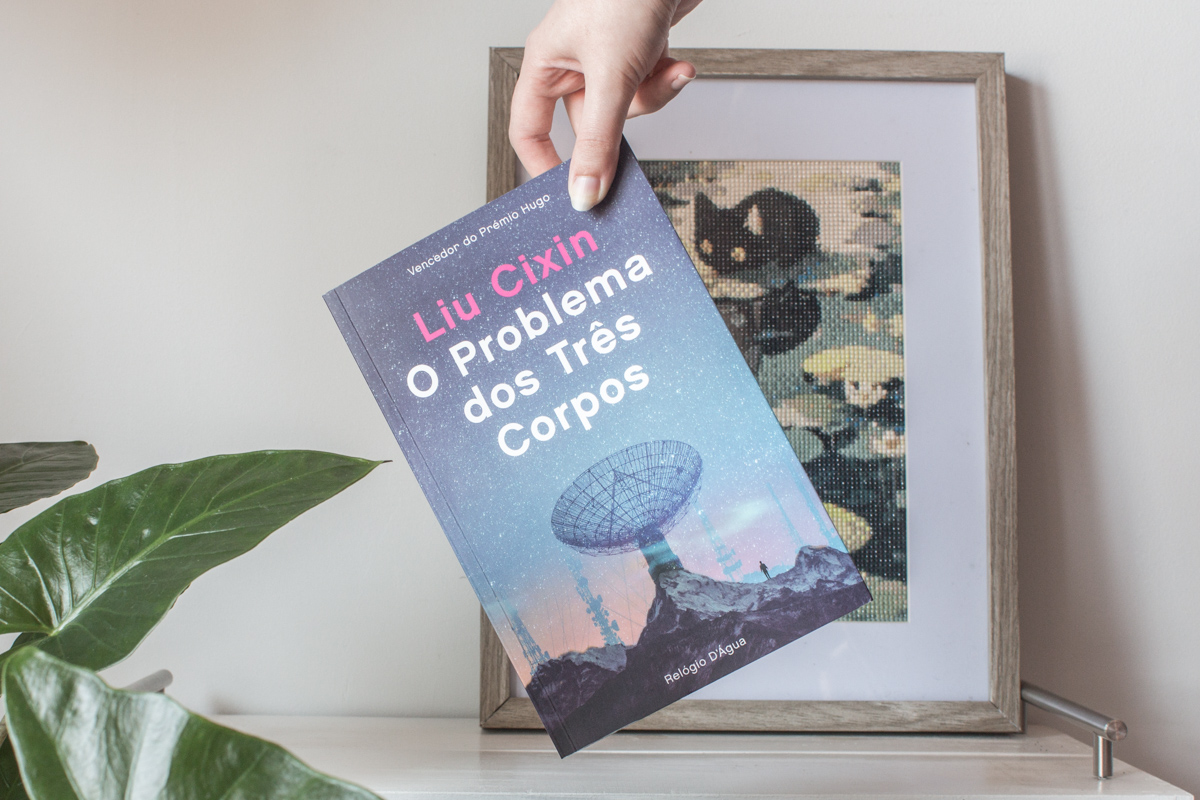
With the new Netflix adaptation, which I haven’t watched, The Three-Body Problem by Liu Cixin is now even more popular. If you enjoy reading sci-fi, then you probably heard people talking amazingly about this book. At least, I did. I had The Three-Body Problem on my radar for a very long time. So long that some promo images of 1899 made me question if the two stories were at all related. Sadly, they don’t. So, I will continue to live without a second season of 1899 and a grudge about it.
Title: The Three-Body Problem Author: Liu Cixin Series: Rememberance of Earth’s Past #1 Publication year: 2006 Length: 13 hours 26 minutes Genre: Hard Sci-fi, Mystery Pace: Medium Story focus: Plot
I knew barely anything about this book series. I know what the three-body problem is, but I had no idea how it would connect with the story. So I went in completely blind, only knowing this was a very beloved book. And I guess that’s the best way to do it.
Even if I thought about writing a synopsis, I don’t know where to start. Only by page 80 do we learn what the three-body problem is in the context of the story. Only 100 pages later, it becomes clear what the story is really about. The author takes you on an unknown journey, and the only thing you can do is sit back, relax and enjoy it.
Although I can’t leave you in the dark. So here’s what I’ll say. Search for the Chinese Cultural Revolution. You don’t need to know much about it, just what it was and then save some time to mourn our lack of humanity once more. That’s where the story starts. Only much later will you understand why the story begins in the 60s. But that’s part of the journey.
Then, you also need to keep in mind that this is classic science fiction. While it was published in 2006, it doesn’t read like the contemporary sci-fi we are now used to. It doesn’t rely on technological advancement to tell the story. It’s not about a world with flying cars, paper-thin glass phones, retina implants or AI and androids roaming around. It’s not even set in the future. And because of that, it falls into the same structure as classic sci-fi: explore human nature. The story is about humanity as a whole, dealing with an ever-changing world, questioning what makes us humans and what that even means. It’s philosophical and political. This means there isn’t much action. It’s written to make you think and realise that, sadly, some of the dystopian horror portrayed was actually real and not fiction at all. But I’m fine. This is fine. I’m not scarred for life at all!

But not everything is perfect. While I was constantly thinking about the next time I would pick the book up again, it has some shortcomings. The final few chapters were quite difficult to read, and that’s not usually how books are designed. You know when the villain reveals his evil plan just before the hero saves the day? It’s like that, but the explanation is two hours long. It was too dense. And while I was reading it, I kept thinking, “Why are you telling me all this right now?”. I think it was information that should have been sectioned and revealed in the next book or two. And story-wise, I feel like it doesn’t make sense either. It revealed too much. But like the cliche villain story, the revelation of the plan is what gives the hero the idea of how to stop it.
I also couldn’t avoid drawing some parallels with Project Hail Mary by Andy Weir. Despite both being very different from each other, the common ground the books share is beautifully explored in Weir’s novel, which puts The Three-Body Problem to shame. This is something I’m expecting to be more developed in the upcoming books and, with a little bit of hope, could become a better part of the story. But I don’t think it will ever reach the threshold Project Hail Mary set.
Most, if not all, of the things I didn’t like as much about the book made me question the author’s capability. I don’t care if a story is scientifically accurate as long as you can sell an idea to me. And some of those ideas didn’t convince me, and they sounded more like not even the author know what he was talking about. And when we enter that realm, then we have a problem. I’m losing trust in the author to deliver the story. I saw some reviews stating the author isn’t the best writer, but I didn’t have a problem with the book overall. It’s just a detail here and there that I wasn’t expecting to find in such a highly praised sci-fi novel. But those same people also loved the rest of the series. So there are a lot of mixed feelings here.
Still, the hype is well-placed. It’s like doing a puzzle without ever looking at the box. Piece by piece, you start to see the picture. And that is its strong suit. Then, you add philosophy and politics, and the picture comes alive. It was so interesting to see this world, get to follow these characters and uncover the mystery of what the story is about. It was highly entertaining, even though that final part made me seriously question everything.
Goodreads | The Storygraph | Literal

And finally, for the spoilers (because I have a bone to pick)
Going back to the master evil plan, why did the Trisolarians, in excruciating detail, reveal the sophons? If they want to break science and prevent progress from being made, then don’t reveal how you are changing the results. The atmosphere can influence the data from ground telescopes. We know that. So, we adjust the data accordingly. But even if you can’t adjust because the sophons are an AI that can adapt and has an unpredictable or inconstant influence, that doesn’t mean we can’t find a workaround. We have smartphones nowadays, and once did science based on the idea that the entire solar system revolved around Earth. And yet, we still managed to evolve. The best way was to send the sophons and not reveal a single thing. The science would be in a huge crisis. We would have no idea why. And that would put us a step back. We would take so long to figure out what was happening because once you know, you can immediately start looking for ways to go around the problem.
But my beef with the Trisolarians doesn’t end there. They were presented with many assumptions. It’s quite hard to talk about alien life. They are either just like us, or if they are too different, it’s hard to communicate and understand. Although to me, it’s too egotistical to have an alien race so similar to us. The way they live, the way they think, the way they act, it’s not alien at all. And in that sense, Andy Weir’s Project Hail Mary does a much better job at that. The Three-Body Problem skip the complications that would be to connect with another life form, and I would be okay with that if it wasn’t for the 32 pages of recognising them like ourselves.
And don’t even make me start on the galaxies. I don’t know if this was a translation issue, but if not, then I’m confused by the choice of words. In the game, the Trisolarians decide they have to leave their home planet and look for another more stable solar system. It says they are leaving their galaxy and looking for another planet, maybe in the Milky Way. So they live very far away from us. But then, just 3 pages later, it says they are going to their nearest star, 4 light-years away. So they are not leaving their galaxy. And then we discover WE are the star 4 light-years away. So they aren’t leaving the galaxy, and they are already in the Milky Way. I was so confused that I thought I had missed something. I read and reread the passages over and over again to reach the same conclusion. It doesn’t make sense. Why speak of galaxies when you could just say solar systems? That would work for any inside or outside of the galaxy you are in.
But that’s not the only time this happened. Oh no. In that dense Trisolarian chapter, they give an example that if humans went to other planets of their own galaxy (which is also the Trisolarian galaxy) and built particle accelerators to avoid the influence of the sophons, the Trisolarians would be able to create even more sophons in that same time to erase any progress humans could make. Now, I understand the point this example is trying to make, but there are so many layers that it loses sense. The Trisolarians consider our use of particle accelerators to be rudimentary science, and they know we are not advanced enough to travel to the other planets in our solar system. Let alone explore other solar systems. Then, they know how long it takes to build one particle accelerator on Earth, and that would mean we had to add to that the time it would take to reach a planet in another solar system. And finally, the Trisolarians would reach Earth before the humans could even reach the next planet. We know Trisolaris is the closest solar system to Earth. If that’s not an option, then we have to go to the second closest. And even if the humans were as advanced as the Trisolarians and could travel at the same speed, then the Trisolarians would always reach Earth first. It makes the argument pointless.
Well, of little this rant as nothing. Ups! Although I had to explain why these things bothered me, because they seriously affected my view of the book. I had no questions that I wanted to read the rest of the series up until that ending. And while I’m still curious, at the same time, I’m questioning if the author will be able to deliver a good continuation to the story. One part of me believes that yes, obviously. But another lost a bit of hope. Maybe all these problems will have a justification or a conclusion, or not matter at all for the story that is yet to come. I don’t know. But was the enjoyment it brought me enough to carry on despite my pet peeves?
Yes, it was. I already have the next book on my shelf.