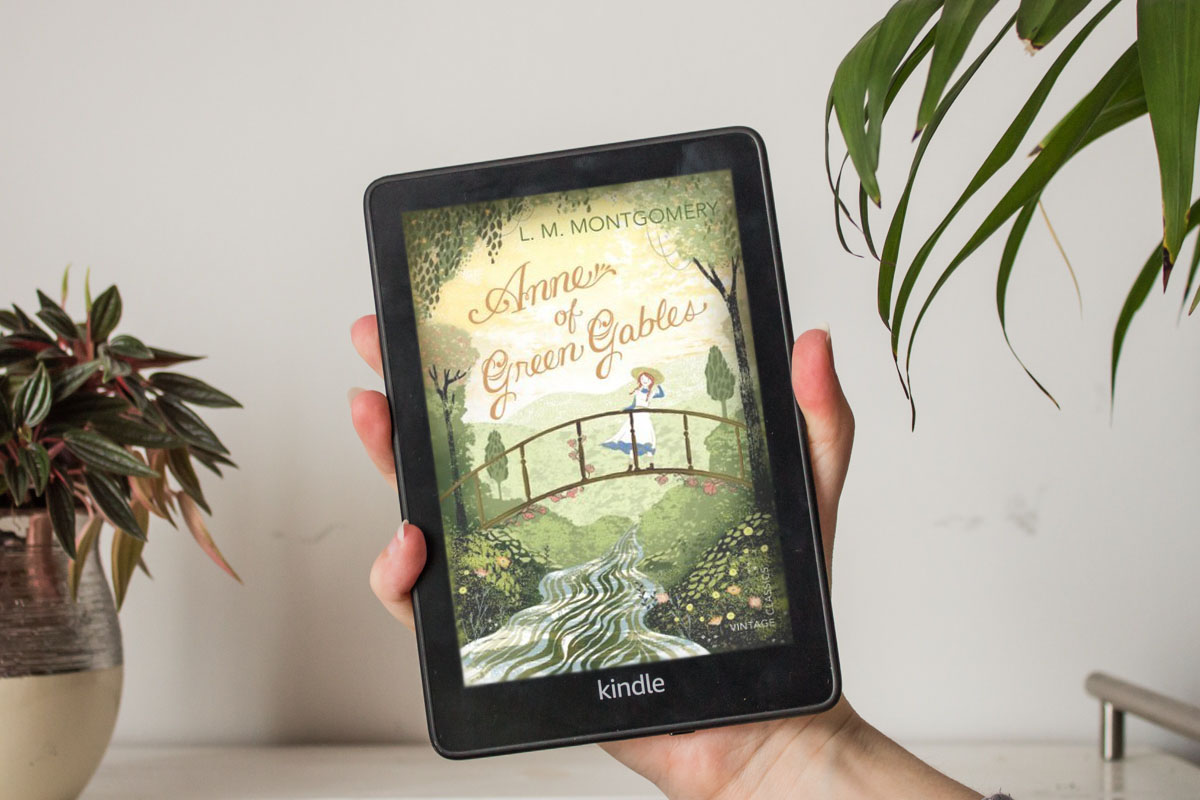
One of the most beloved classic novels, Anne of Green Gables by L M Montgomery, has been comforting people for more than 100 years. It’s hard to find someone who doesn’t like this book, so I’m going to make the job easier for you. Hi! I’m someone who didn’t like Anne of Green Gables. And I’m going to explain why. Some spoilers will be discussed in this review.
Title: Anne of Green Gables Author: L M Montgomery Series: Anne of Green Gables #1 Publication year: 1908 Length: 9 hours 22 minutes
Genre: Classic, Middle Grade, Fiction Pace: Medium Story focus: Character
Eleven-year-old orphan Anne Shirley has just arrived at Green Gables, and already her guardians want to send her back. First, she’s not the boy the Cuthberts expected. Second, she talks too much. And even with her generous spirit, the redhead’s a trouble magnet. Still, despite a rocky start, the fiery Anne wins over her guardians and her new community.
Before going into my problems with this story, I want to first highlight the good that it has. I can see all the things that make this story beautiful. The nature descriptions are a treat for the eye, and if Tolkien writes nature like this, then I’m sure I’ll enjoy reading The Lord of the Rings next. I wish to visit Avonlea and spend an afternoon drinking tea while gazing at Green Gables’ beauty. I saw a passion for nature and a big appreciation for its beauty. Like Anne, I do like to gaze at a landscape and see the birds flying around, and all the life that exists around us.
Anne’s imagination reminds us to find the beauty in the mundanity. It’s up to us to see the beauty around, because it exists, we just have to stop and look for it. To see the bees going from flower to flower. The flow of the water downstream. To embrace life as it comes and make the best of it. To approach something new and something old with the whimsy of a child who is seeing something for the very first time.
These are the things that make readers fall in love with Anne of Green Gables, and I can also see how beautiful and poetic they can be. However, Anne of Green Gables is a product of its time. Just the first chapter, how the characters talk about children as if they are mere products you choose from a shelf. Anne’s red hair is seen as something negative, a sign of her wicked personality or even a curse. And I understand that all these things come from the time period when the story was written. Although I can’t shut a blind eye. I can’t fully enjoy this story while I witness some things happening on the page.
This book and I didn’t start on the right foot. The story begins with such a lack of affection for another human being, specifically a child, that it didn’t go down well for me. It was a shock to start reading such a highly praised book and being met with a huge lack of empathy and humanity, even. Again, a product of its time. But why wouldn’t anyone talk about it? I kept reading in the hopes that something would change. Maybe this was an ideology at the start, but by the end, the characters would change. Sadly, it never did.

One of the things that I disliked the most was how Anne’s imagination was used as a cure for all her problems. Anne’s imagination is so powerful that she forgets her trauma. Although her imagination is a coping mechanism. We don’t know everything Anne has been through, but we know she has been a rejected and neglected child since she was born. And we don’t need to know anymore about her past. She has childhood trauma. Period. And her imagination is a way for her to feel better. In the depressive environment of the asylum, her imagination was what brought her joy. And since all her life was in environments that robbed her of joy, she learned to imagine and appreciate any little moment, even if she is spending only one night at Green Gables.
However, coping mechanisms are not a cure. They don’t fix anything. They exist to support the pain and prevent further harm. And often her imagination is seen as the cure. She can imagine better times, so she’ll be fine. No, she won’t. Throughout the whole story, every time something went wrong, Anne’s reaction sounded like a cry for help to me. I was never expecting this book to go over mental health problems and such. But at least to have characters that would show more compassion. Characters that would accept her for who she is. Characters that would prove she doesn’t need to do anything to be worthy of love. Characters that would show unconditional love. The one love children need to grow.
Slowly, I realised that my problem lay with the adults. They don’t own up to anything, and Anne is their preferred scapegoat. The scene with the necklace is the one most striking for me. Anne is blamed and grounded for taking a necklace without permission and losing it. She is grounded and prevented from attending a picnic she really wishes to go to until she confesses. So the next day, Anne confesses. She lost the necklace. But it’s a lie. Marilla was the one who misplaced it and forgot about it. So Anne was given two choices: to stay grounded and miss the picnic or confess to something she didn’t do in the hopes that her punishment would be lifted. She chose to do what gave her the outcome she wanted the most. It’s wrong to lie, but Marilla didn’t give her much choice.
Much later in the story, this event is mentioned as a lesson that Anne learned, to never touch things that don’t belong to her. And while that’s a good lesson, it wasn’t because she touched what she shouldn’t that the necklace got lost. That was Marilla’s fault. And she didn’t properly apologise to Anne for accusing her and forcing her to confess to something she didn’t do without the benefit of a doubt. And the scene with the cake. Another lesson Anne learned that wasn’t her fault. Did Marilla apologise for putting things in the wrong containers and not tell anyone about it? Of course not. Dumb Anne couldn’t even sniff what she was putting on the cake. It’s her fault. Let’s ignore that she was actually sick and deprived of one of her senses. Because God forbade an adult owns up to their mistakes and apologises to a child.
In the middle of all the pleasantries, I saw a child with a history of rejection being used as everyone pleases. She would lie. She would cry. She would do even a handstand if that gave her a place at Green Gables or the tiniest bit of love. Anne is a straved child. Starved for love. And while I don’t think it was done with intention, it’s just how things were, the adults kept her in that state. It was never a “no matter what mistake you make, we love you”. And that’s the only thing a child needs. And Anne needed that more than anyone.
Also, Anne’s whole story with her body image wasn’t fun to read. She handled so well her first encounter with Mrs Lynde regarding her appearance that I thought it wouldn’t be a thing in the story. And Mrs Lynde even changed her posture towards Anne afterwards, which I really liked to see. She didn’t apologise but recognised it was rude of her to make such comments. Although from that moment on, there wasn’t a moment that felt Anne was accepting that she looked beautiful the way she is. Even in the hair dye scene, what she learns is to not be vain. She still doesn’t like her red hair, but green would be worse. The hatred for her appearance is still there. While at the time, redheads weren’t exactly celebrated, the other characters don’t push Anne away because of her hair colour. But they also don’t encourage her to see it differently. She hates it, and everyone else agrees with their silence. It would be better to see Anne accepting and loving her hair despite it being undesirable.
To end this review on a more positive note, I want to mention one of the best moments of the whole story: the carrots scene. When Gilbert teases Anne for her red hair, calling her carrots, and her immediate reaction to fight back, making Gilbert apologise straight away, should be applauded. That kid was teasing and mocking her appearance. When she fought back, he realised she felt hurt, and apologised to her on the spot to never repeat the joke again. That kid could have become a bully, but instead chooses not to. And that should be acknowledged and celebrated as something positive and something that all kids should do. He made a not-so-funny joke, hurt someone, and apologised. Most adult egos don’t allow this type of reaction. So when it happens, it should be praised.
I started reading Anne of Green Gables to fall in love with the story like everyone else. As it turns out, there is a lot more of the time period of when it was written than I thought. The message of Anne of Green Gables still stands. As adults, we need more whimsy. We need our inner child to come out more often, to enjoy more the little moments in life, not just the big ones. But this story is also a product of its time, and that shouldn’t be overlooked. It’s possible to enjoy something and recognise its flaws. And to me, those flaws prevented me from enjoying this story like everyone else seems to. I really thought that time wouldn’t be a problem for this story, but I was wrong.
Goodreads | The Storygraph | Literal | Fable