The past few weeks have been very exciting for anyone with a slight interest in space news. The Artemis II mission successfully sent four astronauts to orbit the Moon for the first time in over 50 years. Everything, from the launch to the safe return to Earth, was live-streamed on YouTube. And it’s just crazy to think that I can be sitting on my couch watching views in real time over 384 thousand kilometres away. But truly, the best part is witnessing something I’ve only read about, watched movies, or seen pictures.
The last Moon mission was so long ago that my parents were mere babies when it happened. And that’s not even the first time that humans set foot on the Moon. For many generations, this is the first time they are witnessing such an event from our past with their own eyes. A second chance to see what we’ve all read in the recent history books.
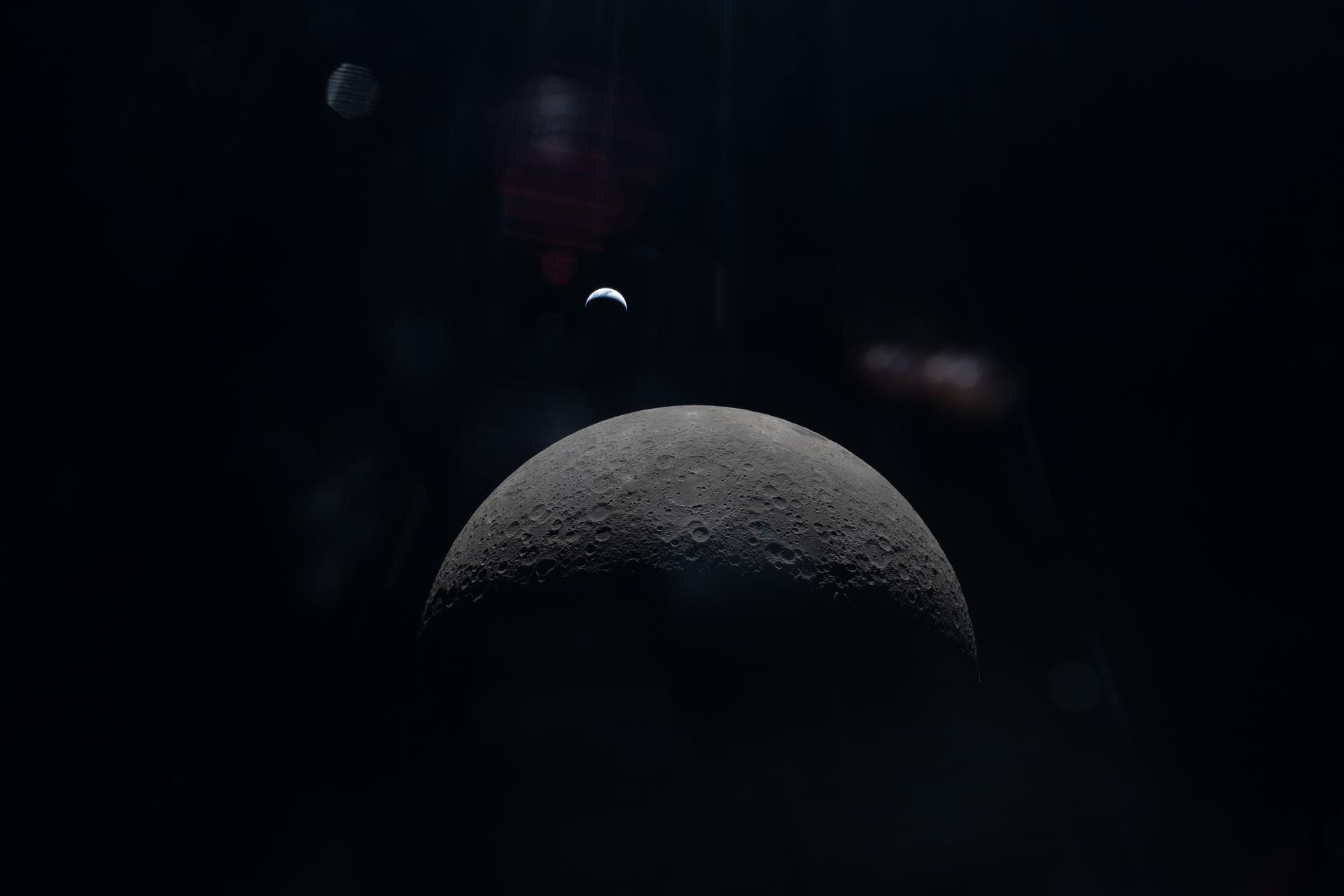
Although apart from the historical significance of the mission (the furthest humans have travelled in space and Victor Glover became the first POC to travel to the Moon), the photographs the crew took from the windows of the spacecraft are what I’ll cherish the most. When I first looked at that photo of Earth setting, the texture of the Moon just seemed off. Not in a “it’s CGI” kind of way or, to keep up with the trends, say “it’s AI”, instead, an oddity that makes the imagination work.

To be fair, even photos of Earth out in space, a blue marble speckled with white clouds, seem odd among the pitch-black darkness of space. It looks out of place. There’s nothing here on Earth that quite matches how strange everything is in space, outside of our daily bubble. Because that’s where we live, in a bubble of oxygen and nitrogen held by the force of gravity that actually isn’t a force at all. Why search for magic when we have science? It makes your head hurt, it’s strange AF, your mind can’t comprehend, and you’ll for sure feel stupider. It’s amazing!
As a sci-fi reader, I always want to experience new planets, but simply looking at the Moon, I now realise that I’ve been doing it wrong. I don’t need to imagine a new, strange planet in a strange solar system. Our closest neighbour is already weird enough and so foreign. There’s no need for light-years distances or made-up worlds. The Moon is enough to put the imagination to work. And I want those books. I want to live on the Moon. I want these photos to inspire sci-fi authors as they inspire me. I want them to take me there. And I know there are already books set on the Moon, but these photos are special, and they deserve new stories.
While mentioning stories set on the Moon, there is one extremely obvious book that comes to mind. No, it’s not Jules Verne, it’s Artemis by Andy Weir. Not only are the new lunar missions called Artemis, but the adaptation of Project Hail Mary is also in theatres. We can travel to Tau Ceti and then come home to travel to the Moon. What a great time to be a science-fiction lover! And with so many people discovering and rediscovering Andy Weir’s novels, it’s only fitting to address the elephant in the room.
Weir is an amazing author at doing one thing: making hard sci-fi fun to read. Science fiction in general is very gloomy, serious and often has high stakes, so there isn’t room for funny business. The reader is supposed to fear for the characters, for what might happen next. And we still feel that in his books, but the humour offsets that feeling a lot, making the reading experience more enjoyable instead of nerve-wracking.

Both The Martian and Project Hail Mary are some of his best works. But they don’t come without some criticism, especially in the character department. While Weir can make reading about real science fun, his characters are the pinnacle of “the nice guy”, and Artemis has a female main character for a change. She has the same type of humour as Mark Watney and Ryland Grace. Although it might not be the best representation of both the female genre and the character’s ethnicity and religion (she’s an Arab woman raised under Muslim beliefs). I’ll leave that judgment for someone who can speak on that behalf. Personally, the female main character didn’t bother me. She’s more of a guy with boobs, but I was more interested in the plot than in reading a great female character. And that’s where I find a problem.
Artemis is pitched as a heist novel. There is a colony set on the Moon, mostly for the rich, since it’s not cheap to travel to the Moon. Although the story follows the working people of the colony. While the final product might be for the rich, the ones who build it and keep it running are the poor. The story delves into the social economics of creating a new territory, and it can be debatable how the author handled the topic. Although it’s still a starting point for such a conversation.
However, while being presented as a heist novel and the plot starts developing that way, it’s not. At some point, there is a shift in the plot that puts the original path to the side and becomes something else. That necessarily doesn’t have to be a bad thing, although it’s not the story that I was expecting to read. And I really wanted a heist.
Expectations aside, the Moon colony is actually really interesting. I liked a lot how Andy Weir built it and the visuals he gave of it. Where the rich live is a lush and vibrant piece of Earth that I wish to spend more time in. But books don’t always have to transport us to a different place. They can also enhance our experiences here on Earth.

A while back, there was a sci-fi book I reviewed that was okay. I enjoyed my time with it, but not to the extent of keeping it on my mind. That book was Under the Heavens by Ruth Fox. What I wasn’t expecting was one single decision to make this seemingly banal book gain a special place in my heart. I was listening to the audio version, and one night, I decided to listen to it while stargazing. My experience of both activities was exponentially increased. I was looking at a sea of stars while listening to the author describing that same viewing experience. I imagined the ship travelling among the stars, too small for me to be able to see it.
Since then, from time to time, I want to relive that experience again. I want to reread the book, to make that travel along with the characters. And this is in a way what Dr Becky talks about in her YouTube channel. As an astrophysicist, she loves space because it’s a pool of possibilities. We never know what we might find. And when we let those possibilities expand the imagination, it’s a beautiful experience. And that’s what fiction really is: imagination brought to life.
I will never forget reading 2001: A Space Odyssey by Arthur C Clarke and the beautiful connection to later images of the Voyager 1. For context, 2001 was written in the 60s and, unlike the movie, it’s set on Saturn’s moon Iapetus. When Clarke decided to set his story on that moon, there was barely any information. So almost 20 years later, when Voyager 1 does a fly-by and takes the first picture of the moon, it looks like the monolith Clark describes can actually be there. And this merge of reality and fiction is so beautiful. It fuels even more of that pool of possibilities. It makes the imagination work and leaves our inner child very happy.

Can you tell that I really love sci-fi? Although I wasn’t always a big fan of space. In a fictional realm, it was okay, but in real life, it was often too overwhelming for me. Looking up at the night sky. The truest of blacks your eyes have ever seen. Dots of light that can contain who knows what. It was too much. But little by little, I’ve been looking up more. And while looking closely at some celestial bodies can still be a bit overwhelming (thankfully, I don’t have a telescope, only a pair of binoculars), in the comfort that I can find, it’s actually quite a grounding experience. Even when the mind takes flight to other worlds.
Cover Image credit: NASA – April 6, 2026